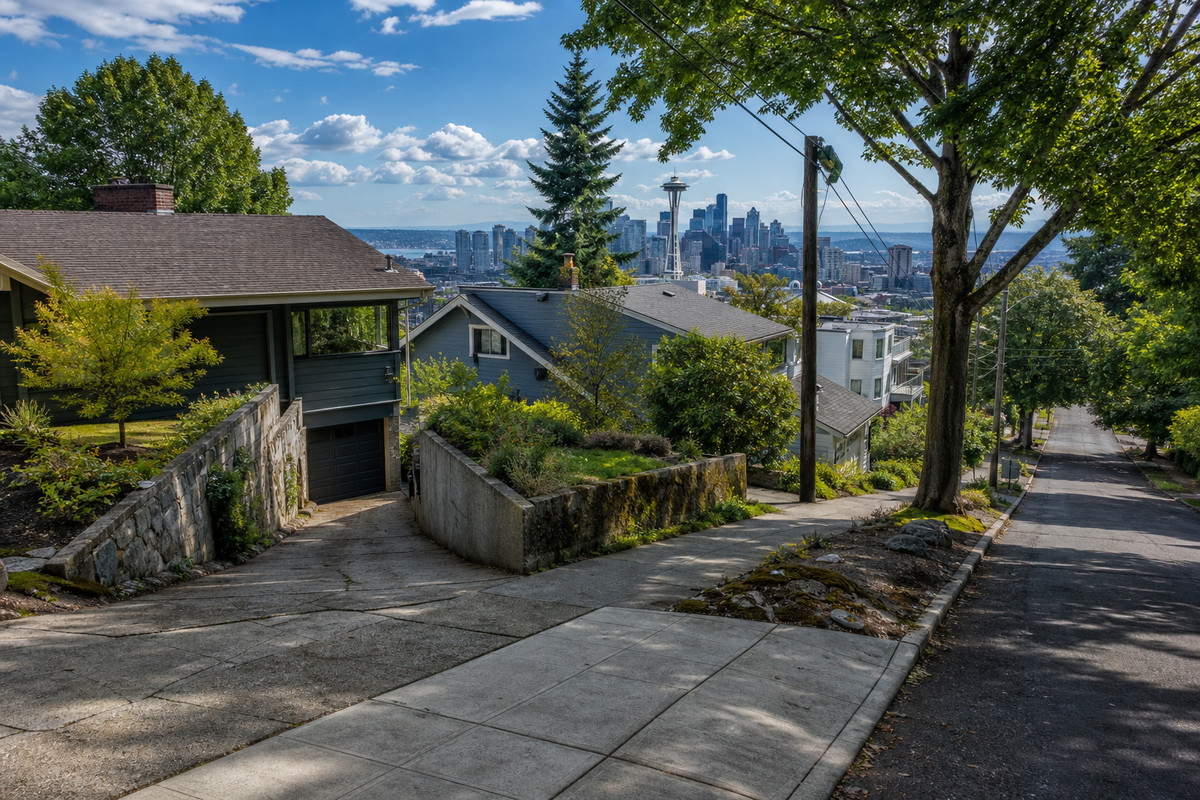
Greater Seattle, the Eastside and the South Sound
Our busiest map in Washington, and the depot sits inside it. On most jobs here the date is a scheduling question rather than a distance question. Typical delivery 1-2 weeks.
This is the busiest delivery map in the state and the depot is inside it, so on most jobs the date is set by the truck schedule rather than by the miles. What actually decides a Puget Sound delivery is almost never the haul. It is the approach. A tilt bed needs roughly one hundred feet of straight, level run to slide a 40ft container off the deck, and closer to seventy for a 20ft. In Ballard, Wallingford, Beacon Hill, West Seattle and the older blocks of Tacoma that run usually has to come off an alley or a shared drive, and a mature street canopy or a low service line settles the placement before we ever load. Grade is the second question, because this city is built on hills and a driveway a pickup climbs without noticing is a different proposition under several tons of steel on a truck deck. The ground splits cleanly too. Glacial till and hardpan up on the ridges is excellent to set on, while the soft fill and peat down in the Duwamish, the Kent Valley and the Puyallup and Nisqually deltas means blocking gets planned in advance instead of improvised. In Orting, Sumner and Puyallup those conversations happen alongside the lahar route signs everyone in the valley already knows by heart. Traffic sets our windows more than weather does, so we work the I-5 and I-405 corridors and SR-167 through the Kent Valley outside the peaks, and we settle the bridge and tunnel routing for a loaded truck before dispatch rather than at the on-ramp. Contractors, remodelers, restoration crews and the warehouse and light manufacturing tenants between Renton and Fife are the steadiest buyers, with Eastside homeowners close behind.
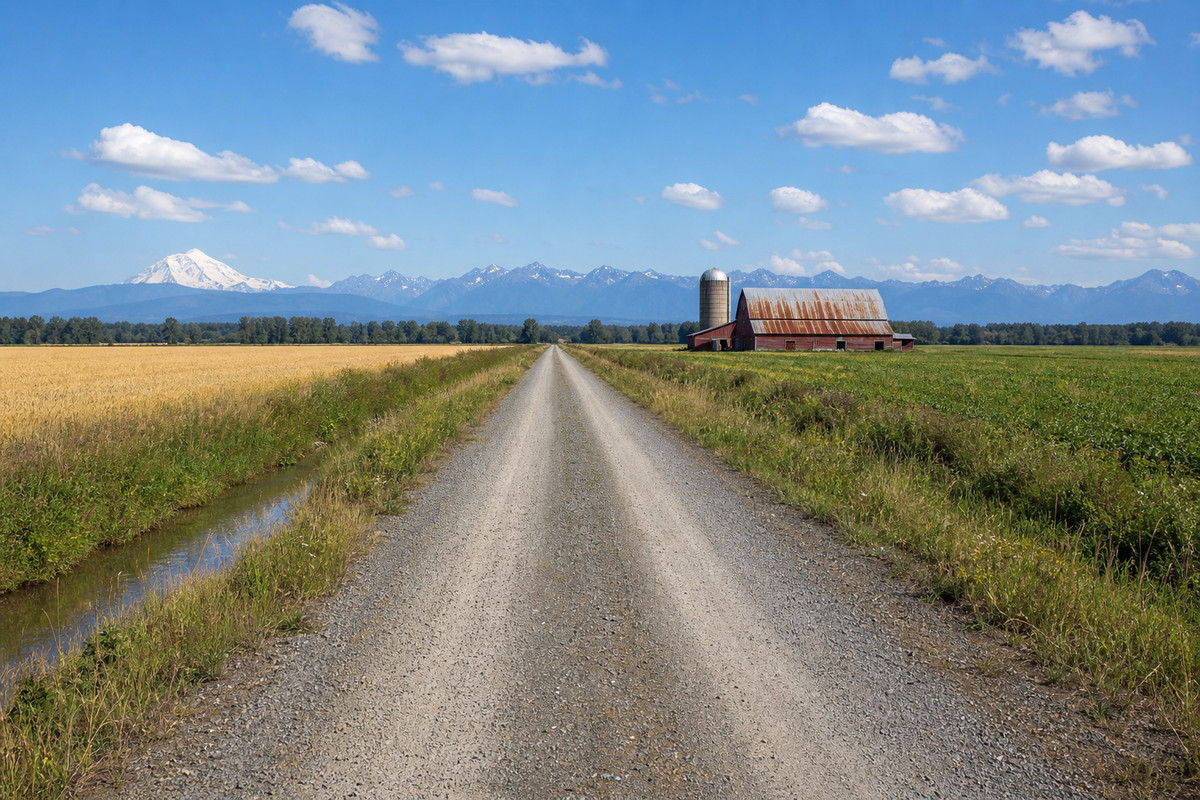
The North Sound and the Islands
Straight up I-5 from the depot, with two very different problems waiting at the end of it: river valley ground and the ferry schedule. Typical delivery 1-2 weeks.
North of Everett the map opens up and the run gets simple, right up until it does not. I-5 carries us to Mount Vernon, Burlington and Bellingham without drama, and most placements in the Skagit and Nooksack valleys are a straight pull off a county road onto flat, open ground. The two things worth planning around up here are water and water crossings. The Skagit and the Nooksack both flood, and the low roads around Conway, Fir Island, Everson and Sumas go under in a wet winter, so a February date on river bottom ground earns a phone call about the last quarter mile before it earns a truck. Counties here post seasonal load limits on their own roads through the spring thaw, and while those are up a loaded truck is not going down a soft county road no matter how good the schedule looks. The islands are their own category. Anything bound for the San Juans, Lummi or Guemes rides a ferry, and Washington State Ferries takes vehicle reservations on only two runs statewide, one of them the Anacortes to San Juan Islands sailing. A commercial vehicle that is oversize or over the ordinary gross weight needs travel approval arranged with the ferry system ahead of the sailing, and that is a business days process rather than a same day one, so island deliveries get booked around a boat rather than the other way round. Point Roberts is the honest exception up here, reachable by road only through Canada. Berry and dairy country from Lynden to Ferndale, where Whatcom County grows most of the country's red raspberries for processing, the refineries at Cherry Point and March Point, the boatyards at Anacortes and Bellingham and the aerospace supplier shops in Arlington and Marysville are the buyers we see most.
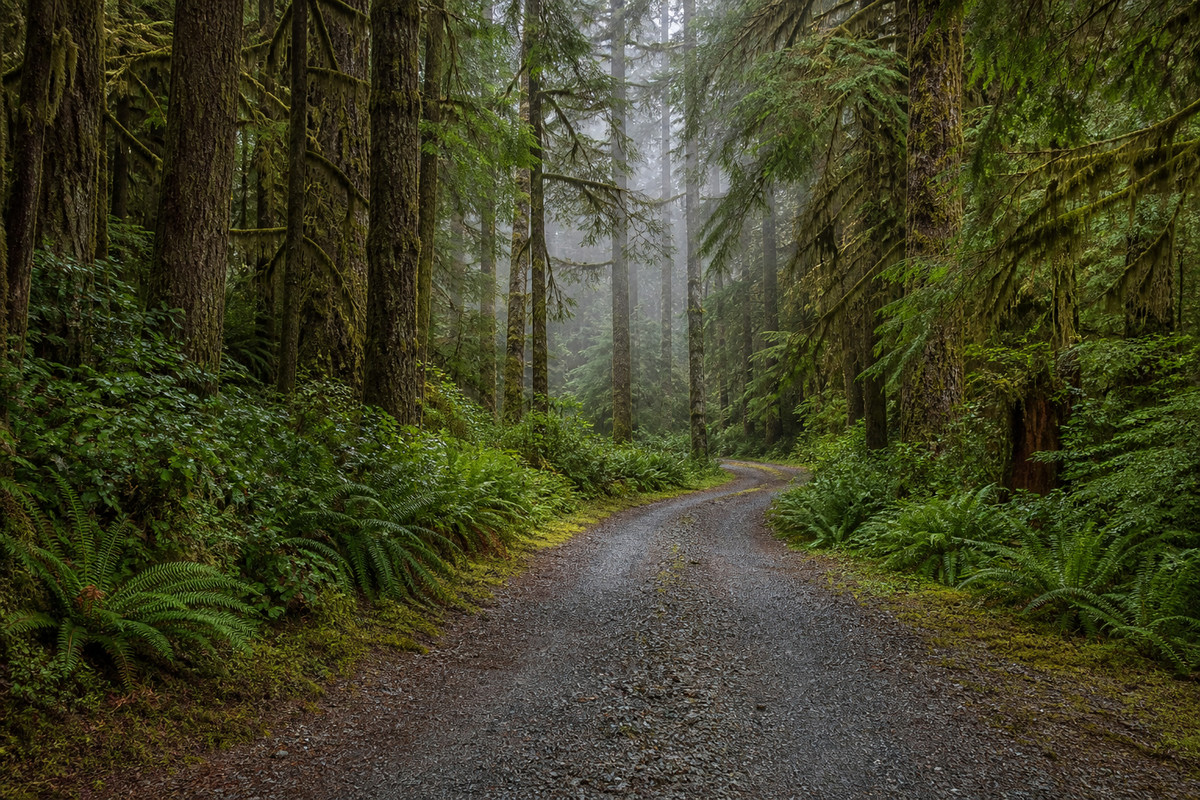
The Olympic Peninsula, Kitsap and the Coast
The region where the shortest line on the map is rarely the shortest drive. We plan the route before we quote the date, and we tell you which way the truck is coming. Typical delivery 2-3 weeks.
Bremerton is about fifteen miles from Seattle across the water and roughly seventy by road, and that single fact shapes everything we do out here. A loaded container truck is not a walk-on passenger. Some Kitsap deliveries make sense on a ferry sailing, and plenty make far more sense around the south end through Tacoma and over the Narrows, or north over the Hood Canal Bridge, which floats and opens for marine traffic and stops road traffic while it is open. The Port Townsend to Coupeville run is one of only two Washington State Ferries routes that takes vehicle reservations at all, which makes it useful and also makes it worth booking early. We route first and quote a date second. West of the Olympics the road is US-101 and there is no alternative to it, so a slide or a closure between Sequim and Forks is not a detour, it is a wait, and we would rather build that into the window than discover it on the morning. Rainfall out here is not a figure of speech either. The west slope is temperate rainforest and the ground stays soft well into summer, while Sequim sits in the Olympic rain shadow forty miles away and is genuinely dry. Two towns that close can need completely different site prep, so we ask rather than assume. On the coast from Ocean Shores down through Westport to Long Beach the constraints are soft sand, a beach approach that looks firmer than it is, and wind, so the driveway surface is always a question. Timber and mill work around Aberdeen, Hoquiam and Raymond, the fishing and charter fleets at Westport and Neah Bay, shellfish growers on Hood Canal and Willapa Bay, and contractors working around Naval Base Kitsap are the steady buyers here.
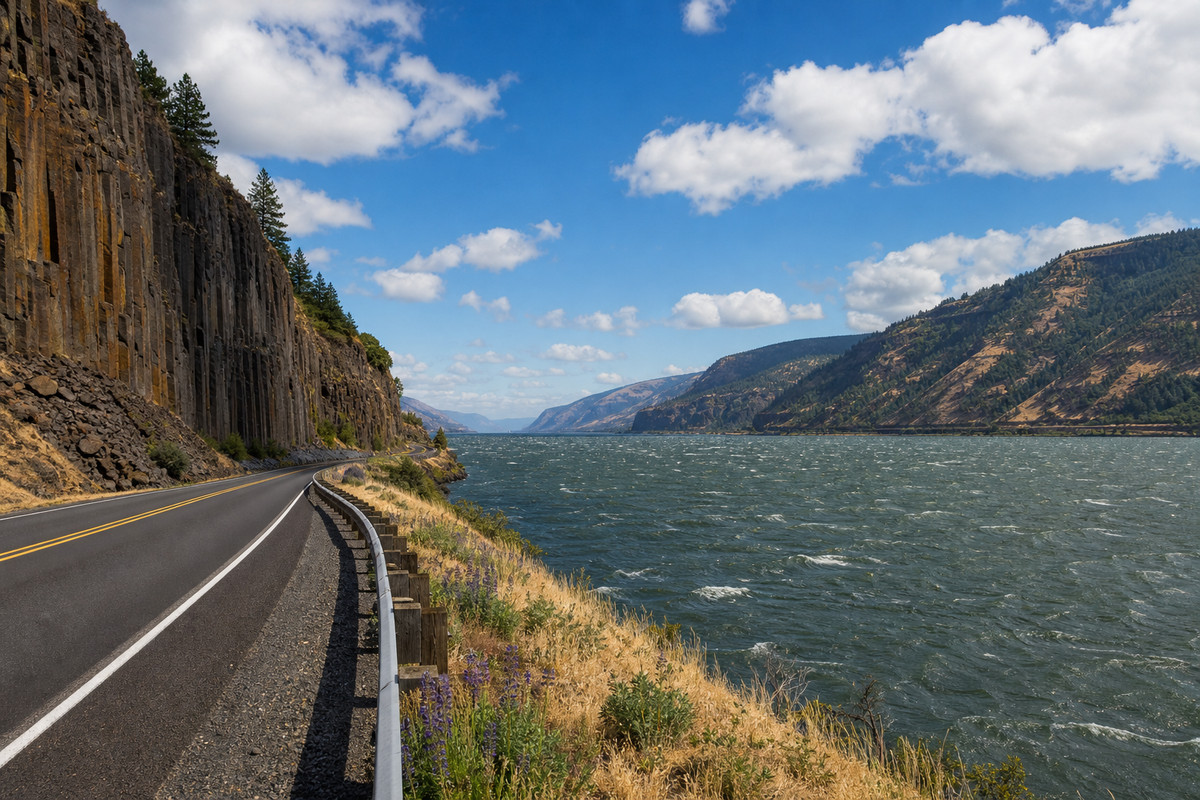
Southwest Washington and the Lower Columbia
A straight run down I-5 from the depot, and the one corner of the state that keeps Portland's hours. Typical delivery 1-2 weeks.
Southwest Washington is the easiest long run we make. It is I-5 the whole way, about a hundred and seventy miles from the depot down to Vancouver, and a comfortable single day for a truck. The thing to understand about Clark County is that it faces south. Vancouver, Camas, Washougal, Battle Ground and Ridgefield share an economy and a commute with Portland across the river, and traffic on the Interstate Bridge and the Glenn Jackson Bridge sets the working window for anyone delivering there, which is why we aim for mid morning or mid afternoon rather than either rush. Ground through most of Clark County is good, firm and workable, and the newer plats around Ridgefield and Battle Ground usually give a truck room to line up. Two things change north and east of there. Lewis County and the Chehalis River valley flood, and I-5 itself has closed through Centralia and Chehalis in serious water before, so a December or January date on low ground earns a conversation about the approach first. And east up the Gorge on SR-14 through Stevenson, White Salmon and Bingen the road narrows against the basalt, the wind funnels hard through the gap, and places to turn a truck around get scarce, so we want to know the site before the truck leaves the yard. One local habit worth knowing: people here say Vancouver USA, because the other Vancouver is two hours north and owns the search results. Wood products and port work around Longview and Kelso, marine trade on the lower Columbia, orchard, vineyard and wind farm service work up around Lyle and Goldendale, and a heavy construction and remodeling trade all through Clark County are the buyers we see most.
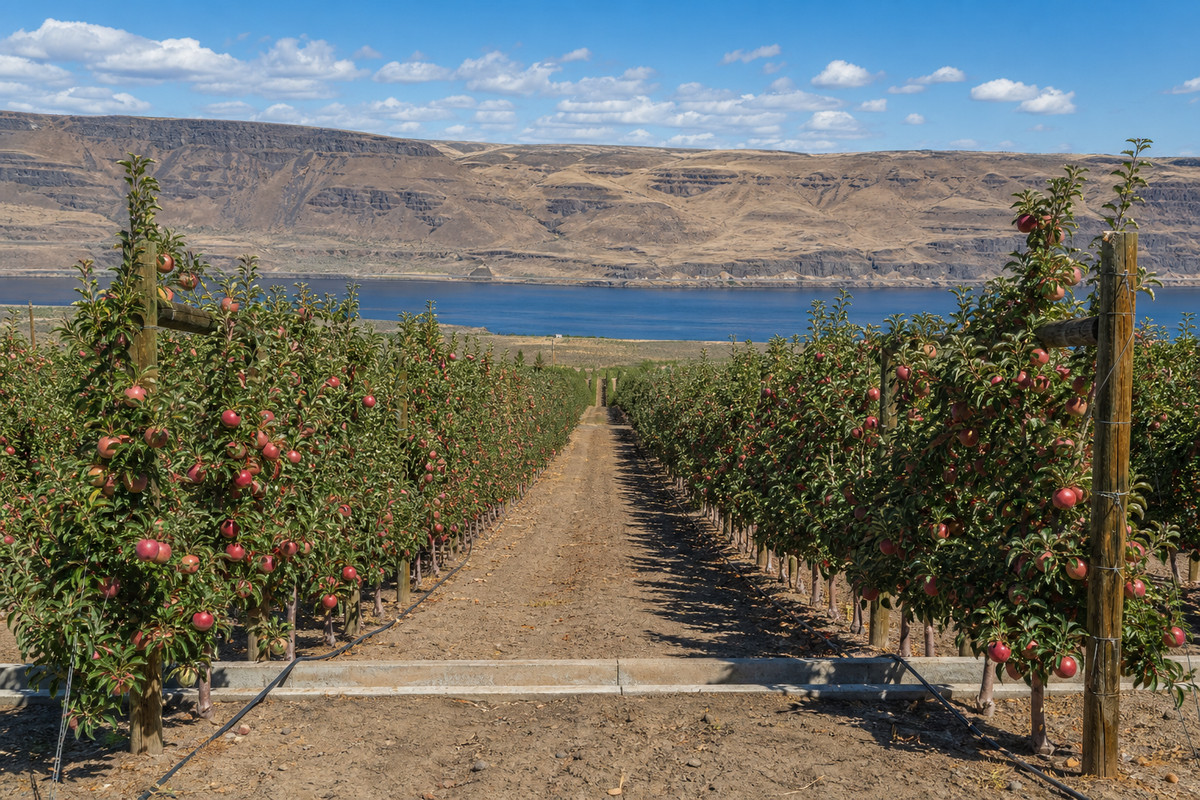
Central Washington: the Yakima Valley, Wenatchee and the Columbia Basin
Over the pass and onto the dry side. Orchard rows, irrigation laterals and a mountain crossing we plan around rather than pretend away. Typical delivery 2-3 weeks.
Everything we deliver in Central Washington crosses the Cascades first, and that crossing is the honest reason the window is longer here. Snoqualmie Pass on I-90 and Stevens Pass on US-2 both close for avalanche control in winter and both run traction and chain requirements for days at a stretch, and White Pass on US-12 is quieter but no different in character. The requirement that matters to us is the one at the top of the scale: when chains are called, they are required on every vehicle over ten thousand pounds gross weight, which is every truck that carries a container, long before the passenger cars are asked for anything. So we do not promise a January date across a pass that we would promise in July, and we say why rather than padding a number and hoping. Once you are over, the ground is nothing like the west side. This is shrub steppe and irrigated desert. Yakima County is the leading apple producing county in the country and the Yakima Valley grows roughly three quarters of the United States hop crop, and orchard and hop ground has its own delivery geometry: row spacing, low trellis wire, overhead frost fans and irrigation laterals all sit exactly where a truck wants to swing, so we ask which end of the block the container is going on. Out in the Columbia Basin around Quincy, Moses Lake, Othello and Royal City the constraints are the canal system and soft, sandy shoulders on the section roads, plus a blow sand season that can shut a highway outright. North on US-97 through Chelan, Pateros, Brewster and Omak the valleys narrow and the driveways get steep. And SR-20 over Rainy and Washington passes is gated shut every winter, which puts the Methow at Twisp and Winthrop on a seasonal route. Packing houses, wineries, hay and potato operations and the data centers around Quincy are the steady buyers.
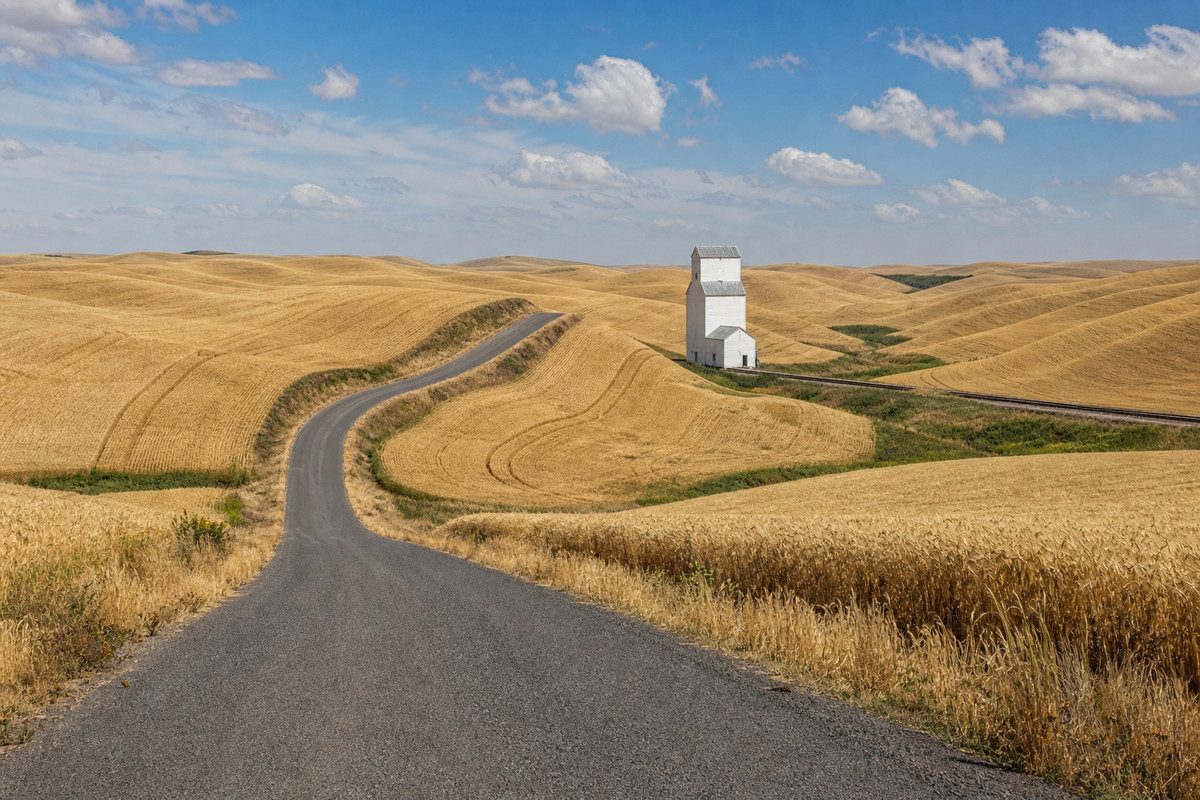
Spokane, the Inland Northwest and Southeast Washington
The far side of the state. Spokane is 279 road miles from the depot over Snoqualmie Pass, and we quote that honestly instead of pretending one number covers Washington. Typical delivery 2-3 weeks.
Spokane is 279 road miles from the depot and every one of them is real, so we quote the eastern side of the state plainly. Delivered pricing here sits above Seattle on every grade for exactly that reason, and the pickup prices in our own capture are effectively the same as Seattle's, which tells you the gap is the haul and nothing else. We would rather explain that up front than have it land as a surprise at scheduling. What you get in return is some of the easiest ground in the state to set a container on. Spokane, the Valley, Liberty Lake and Cheney sit on flat basalt and glacial outwash, and most sites are a straight pull with room to swing. South of there the Palouse is a different animal. Those hills are wind blown loess, they are considerably steeper than they photograph, and a farm approach a pickup takes at speed can be a genuine problem for a loaded truck turning off US-195 or SR-27. We ask about the grade and about where the truck turns around. In spring we ask about weight limits too, because county road departments across eastern Washington post seasonal load restrictions during the thaw, and while those are up a soft township road is closed to us regardless of the calendar. The Tri-Cities are their own economy at the confluence of the Columbia, Snake and Yakima rivers, with the Hanford cleanup, agriculture and food processing all pulling containers at once. Walla Walla, Waitsburg and Dayton run wheat, wine and orchard work on ground that has been farmed for well over a century. Wheat operations, wine country, the Hanford contractor base, the university towns at Pullman and Cheney, and timber country north toward Colville and Kettle Falls are the buyers we see most.